
AI in the Kitchen: Why We're Asking the Wrong Question
Babette PepajShare
There's a story going around this week -- Your AI Doesn't Know It Can't Taste, in The Eastern Herald -- and it's sharp and worth reading. It runs three chatbots through the same recipe queries and watches them split into three personalities. ChatGPT hands you a chicken marsala like it invented the dish. Perplexity points you to a named chef. Gemini cites 29 sources and credits the bloggers who did the work. The verdict is that Gemini wins, because it shows its sources and once, memorably, asked a clarifying question.
Good piece. But I read the whole thing and kept thinking the same thing over and over.
We are asking AI the wrong question.
The entire benchmark -- three engines, four recipes, an afternoon of testing -- is built on one buried assumption: that "AI in the kitchen" means a thing that writes you a recipe. So the only question worth asking is which one writes it best. Who cites better. Who invents less. Who sounds most like a chef.
That's a chatbot question. And we've been so busy grading the chatbots against each other that almost nobody stopped to ask whether a recipe-vending machine is what a home cook actually needed in the first place. It isn't. It never was.
A recipe was never the hard part
Here's the thing twenty years of building for home cooks taught me... nobody was ever really stuck for lack of a recipe. There are millions of them. We had cookbooks, we had food blogs, we had a community at BakeSpace with over 130,000 of them. The recipe was never the bottleneck.
The hard part is everything that wraps around it. And it starts long before you ever turn on the stove.
It's standing in a grocery aisle holding something you can't identify, because the recipe said it casually and the store has four things that might be it. It's 9pm on a Tuesday when you remember you signed up to bring cookies to your kid's soccer practice in the morning and you have not, in any sense, prepared for this. It's your daughter texting that she invited friends for dinner -- and two of them are vegan, one's gluten free, and one has decided this month that they don't eat anything that's ever cast a shadow. (You laugh, but you're also now standing in the kitchen doing math.)
And then it's the cooking itself -- the sauce that's too salty with twenty minutes on the clock, the missing ingredient the recipe refuses to live without, the pan doing something nobody warned you about.
A chatbot is no help at the aisle, because it can't see what you're looking at. It's no help with the four-diet dinner, because you'd have to type out the whole puzzle from scratch and hope. And it's long gone by the time you're actually cooking -- it generated its block of text and walked off. It doesn't know you started. It doesn't remember the last question. You'd have to stop, open a new chat, and explain your entire situation again to a stranger who's never seen your kitchen.
That's not an assistant. That's a search result with a friendly voice. And we've been treating "search result with a friendly voice" as the finished form of AI in the kitchen, when it's barely the starting line.
What a kitchen assistant actually is
Flip the question. Stop asking which AI writes the best recipe and start asking which AI actually helps you cook -- all of it, the whole messy arc from the store to the table. Everything changes. Suddenly the chatbot scorecard -- citations, sourcing, who invented what -- is measuring the wrong race entirely.
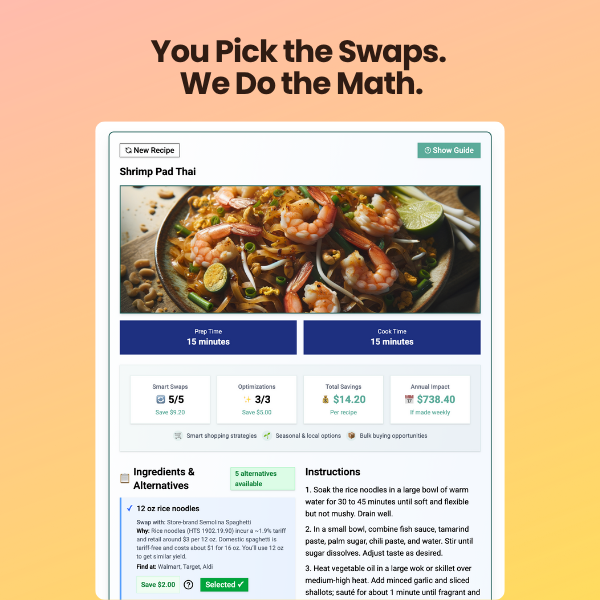
A real kitchen assistant shows up for the parts that were never about the recipe. You're in the aisle holding the mystery ingredient? Ask it what the thing even is and what to do with it. It's 9pm and the cookies are due at sunrise? It figures out what you can actually pull off with what's in the house. Four friends, four diets, one dinner? That's not a crisis, that's just a set of constraints -- it works the whole table at once instead of making you solve it alone.
And it stays in the room once you're cooking. When it's too salty, that's a problem with answers -- add acid, add fat, stretch the batch -- and it works it with you instead of pretending the cook is already over. When you're out of an ingredient, it finds the swap so you keep going with what's in your kitchen, no trip to the store, no abandoning the plan.
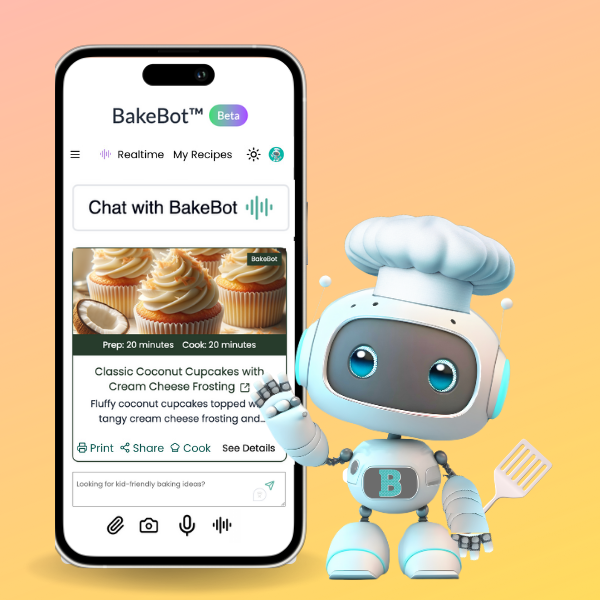
That's what we built BakeBot to be. Not a better chatbot. A different thing entirely -- the part that shows up before, during, and after the recipe, which is exactly the whole stretch where every chatbot quietly clocks out.
This is the shift nobody's naming
The article worries, fairly, that chatbots erase the people who do the work -- the bloggers who test a dish 40 times before publishing, encoding culture and memory a model just scrapes and serves anonymous. I agree with every word. But notice that this is still a chatbot problem. It's a worry about how the recipe got written and whether anyone got credit. It lives entirely inside the old question.
The bigger shift is that the recipe was never the point. BakeBot didn't fall out of a model trained on the open web. It grew out of a real cooking community I started in 2006, full of real people who cook -- and then we built an assistant to help you run an actual kitchen, live, in the moment, from the grocery aisle to the salty pan, not just to print you a recipe and vanish.
That's the change I want people to see. We keep evaluating AI in the kitchen like it's a chatbot with a cooking hobby. Which one writes the prettiest marsala. It's the wrong frame. The question was never "can the AI write me a recipe." Everyone can do that now. The question is whether anything's actually with you for the parts that are hard -- the aisle, the ambush, the four-diet dinner, the pan that's gone sideways.
Most AI checks out at the recipe. That's the whole gap. And it's the entire reason BakeBot exists.
Come see what a kitchen assistant looks like when it stops trying to be a chatbot. It's free at BakeBot.ai -- bring whatever you're cooking tonight, or whatever ambush is coming tomorrow.