
It's Not About Protein: The Real Reason Cottage Cheese Won 2026
Babette PepajShare
Somewhere between the third protein-cheesecake reel and my fourth blended-cottage-cheese-pudding recipe, I realized every food writer covering this trend was getting the story wrong. They keep filing it under "fitness craze," like the only reason a person would put cottage cheese in a dessert is to hit a macro. That's lazy, and it misses what's actually going on in home kitchens right now.
Here's the real story. Cottage cheese is quietly replacing heavy cream and cream cheese in a lot of 2026 baking, and the thing driving it isn't abs. It's that home cooks want the lower-sugar, higher-protein version of a dessert they already love, and they have absolutely no idea how to make the swap without wrecking the texture. That gap -- wanting the healthier bake but not knowing the chemistry -- is the whole ballgame. I'd call it kitchen anxiety, except that makes it sound smaller than it is. It's ingredient confidence, and most people don't have it, because nobody ever taught them why sugar and fat are doing structural work in the first place.
I know this because I ran a focus group on it. My husband and his team built SmartFocus.ai, which lets you run a moderated consumer panel with synthetic participants, and I pointed it at exactly this question: what frustrates home cooks about healthy dessert swaps, which failures actually make them quit, and what they'd want from a kitchen AI. Seven home bakers, a moderator who used to run bakery operations for a grocery chain, and a transcript that told me more in an hour than a month of scrolling comments ever could.
Texture is the boss, and everyone at the table knows it
The first thing that jumped out is that these people do not judge a dessert by whether it's healthy. They judge it by whether it feels finished. Amina, a nurse who makes lemon berry cheesecake for family dinners, said if the texture is even a little grainy or soft in the middle it doesn't feel done "even if the flavor is good." That's a brutal little sentence if you're a brand selling a swap. Flavor is not the pass-fail. Texture is.
And they draw a very sharp line between a mistake you can rescue and a mistake that's fatal. Dry cake? Recoverable. You throw a scoop of ice cream on it and people still eat it. But graininess, curdling, and a chemical aftertaste read as "something went wrong with the ingredients," and once a dessert crosses that line it's done. Darren, an electrician who does not mince words, put it exactly right: "If a custard feels sandy, I'm done with it -- it tastes like somebody skipped a step, and there's no fixing that at the table." That is the failure mode cottage cheese is one bad blend away from, every single time.
Why sugar and fat aren't optional (and why people learn this the hard way)
The part that genuinely moved me was how everyone in that "room" had learned baking chemistry through failure, one ruined pan at a time. Evan, a science teacher, cut the sugar in a brownie recipe by a third expecting "just less sweetness" and got a drier, cakier brownie with a dull crust, because sugar wasn't only sweetening the thing, it was managing moisture and browning. Keisha swapped applesauce for half the oil and got something "edible but a little gummy." Nolan tried protein powder in brownies and got dry and rubbery, and now he'd "rather keep the brownies normal than pretend a bad batch is healthy."
Do you hear what that is? That's a whole roomful of smart, capable AI adults who figured out that sugar and fat are structural, not decorative, and the only teacher they had was wasted ingredients and disappointed kids. Nobody handed them the chemistry up front. They paid for it in gummy cake. So now they all do the same defensive thing: change one variable at a time, make a small cut, test a small batch. Marisol summed up the whole psychology in one line -- "I'm not risking a birthday cake on a vague healthy swap."
Where cottage cheese actually gets a yes
Now here's the good news for the trend, because it's not all skepticism. Cottage cheese has a real lane. The group was open to it, on conditions. Blend it completely smooth, use it where lighter and higher-protein is an acceptable outcome, and put it somewhere the flavor gets rounded out -- a chocolate mousse, a blended pudding, a fruit-forward filling, something baked and chocolatey. Amina said it can work "beautifully in a blended chocolate mousse," as long as there's enough fat or melted chocolate to carry that slightly milky note. That's a genuine permission slip.
What cottage cheese does not get is a one-for-one pass on classic cheesecake, especially the one you're serving to guests. Rocío, who bakes for a big extended family, was warm about trying it in a baked filling but firm on the finish line: "For a cheesecake I'm serving guests, I'd still choose cream cheese -- the richness is part of what people expect." And Darren's whole test fits on a bumper sticker: "If I can see or feel curds, it's a failed swap." So the trend is real, but it lives in a specific set of formats, and the difference between a hit and a "failed swap" is almost entirely whether you blended it smooth and balanced the flavor. Which is to say, it's a technique problem. Which is exactly the kind of problem an AI can help with in the moment.
This is the BakeBot-shaped hole in the kitchen
Here's why I care about all of this beyond a fun trend piece. Every barrier that focus group described is a barrier of information arriving too late. They don't lack willingness. They lack a trustworthy answer at the exact second their hands are covered in batter and the filling looks a little looser than they expected.
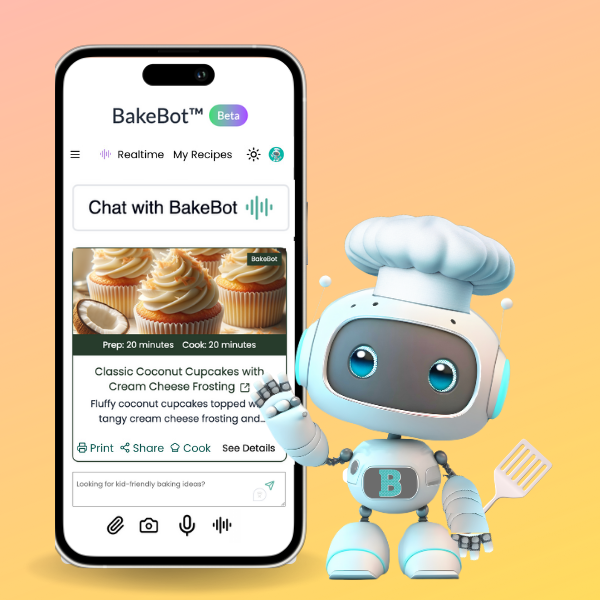
That moment is what BakeBot.ai (and BakeBot on any recipe on BakeSpace.com) is built for. You can ask it, out loud, in plain English -- or Spanish, or whatever you actually cook in -- "How do I swap cottage cheese for cream cheese in my cheesecake without it curdling?" and get a real answer: the amount, what the original ingredient was doing, what's going to change, and what to watch for. Hands-free, mid-bake, right on the step where the anxiety actually lives. Marisol told us she'd want "a quick plain-English pop-up, Spanish available, with exactly what to use and whether it changes the texture. Not a video starting while I've got sticky hands." Rocío wanted "one clear step, large enough to glance at," and the freedom to decide if she wanted more. They basically wrote the product brief without knowing it.
So when we put BakeBot in front of them directly -- imagine a tool that reads your exact recipe and hands you a swap, an amount, a confidence level, and a warning before a likely texture problem -- the answer was fascinating, and it wasn't what a lot of AI products would want to hear.
What they told us they would actually trust is an ingredient swap recommendation that shows its work. The exact swap and amount. Why it works in this specific recipe, not just in general. What it changes -- moisture, acidity, spread, browning, density, crispness. A candid note on the expected result, the "slightly less crisp at the edge" or "denser but still moist" kind of honesty. Evidence that it was tested in this kind of dessert or one built like it. And a fallback for when the batter looks off, the "reduce another liquid by a tablespoon" that Evan asked for by name. Amina put the whole philosophy in one line: she'd use it "if it showed the logic, not just 'swap this for that.'"
The thing they demanded most, over and over, was honesty. (Yes, I see the irony there when they are AI personas.) Nobody wanted a confident-sounding swap that promised identical texture, because they've all been burned by that promise. Nolan nailed it: "The confidence score only matters if it's earned by the result." What earns trust in that kitchen isn't a tool that says everything will be perfect. It's a tool that says "this'll stay moist but come out a little denser" and then turns out to be right. And the adoption path they described is just as clear-eyed: they'd test it first on something low-stakes -- muffins, brownies, cookies -- and keep using it only after the finished result matched what the tool predicted. That's the bar. It's a high one, and it's the correct one.
For the brands reading over the home cooks' shoulders
If you make dairy, or protein products, or bakeware, or you're just trying to figure out where the healthy-dessert market is actually going, the useful lesson here is that you're probably selling the wrong benefit. Health is not the hook. Risk reduction is. These consumers already want to eat better. What stops them is the fear of wasting a whole batch on a swap that curdles in front of company. Sell them proof, not virtue -- cut-open photos, cooled-texture notes, exact ratios, and a straight answer about what changes. That's what converts curiosity into a second attempt.
That's also the entire point of running a panel like this on SmartFocus.ai instead of guessing. In one session I got the failure hierarchy, the exact language people use for a "failed" dessert, the formats where cottage cheese wins and the ones where it never will, the precise moment a home cook reaches for help versus abandons the recipe, and a genuinely counterintuitive product finding -- that a confidence score alone actively fails to build trust, and what has to sit next to it before people will follow the advice. That's the raw material for a product roadmap and a marketing plan, and it came from asking the right seven people the right questions. And I got it in about 15 minutes.
So go blend your cottage cheese completely smooth, put it somewhere chocolatey, and ask BakeBot the thing you'd normally just guess at. The worst-case scenario used to be a grainy cheesecake and a quiet vow to never try again. In 2026, it can just be a question you ask out loud with flour on your hands.